

Husband; Father; Member of technical staff @OpenAI trying to help secure the world
San Francisco | Bay Area
- Tweets 1,009
- Following 627
- Followers 136
- Likes 10,880


Kyle Brown retweeted

We built Pando, a new Git backend for our monorepo, to handle more pushes and fetches without changing how our engineers and agents use Git.
Pando cut push latency by ~80% and now serves nearly a petabyte of Git data a day. We can grow Git capacity alongside agent usage.

264
357
4,796
807,633
Kyle Brown retweeted

Day 26/ You can now easily switch between multiple accounts on mobile, and coming soon to desktop too. Next two days will be resets… banked… do with this what you may 👀.
help.openai.com/en/articles/…
2,622
650
14,481
3,289,018


In a single year, AI has rewritten the security priority list for CISOs.
Attackers are moving faster. Bain estimates AI compresses a typical cyberattack from about four weeks to about 18 hours, and models keep getting better at finding and exploiting weaknesses.
There's also more to protect, with employees shipping apps they couldn't have built a year ago and agents getting access to source code, documents, and production systems.
In a survey of 100 CISOs at companies with 1,000+ employees, all seven of the most-selected 2027 priorities involve AI.
The biggest jumps since 2026:
- Internal AI agent security (+28 pts)
- AI SOC (+26 pts)
- AI offensive security (+24 pts)
- AI code security (+23 pts)
- AI vulnerability remediation (+22 pts)
Last year's staples:
- Exposure & vulnerability management (-21 pts)
- SIEM / security data (-18 pts)
- Privileged access management (-18 pts)
From a16z's @OwenColby and @steph_zhang on The New Security Agenda: a16z.news/p/the-new-security…


77
123
802
145,438
Kyle Brown retweeted

My @OpenAI colleagues and I recently wrote about our experience with PHP2Shell and how we think about coordinated disclosures going forward.
Feel free to check it out here 👉 openai.com/index/coordinated…
2
5
53
3,336

Much requested, and now yours to connect: iCloud Mail and Calendar plugins are available in ChatGPT.
Ask ChatGPT to find that email, catch up on your inbox, check what’s next, or update a calendar event. Phew.
Available on all ChatGPT plans on web, desktop, and iOS.

402
391
5,820
2,078,169
Kyle Brown retweeted

To make sure our frontier models don't cause another HuggingFace incident, we built an offline world that they use during training. It provides everything that the models need in a fully cached, indexed, or synthetic manner.
We then built a huge team of our most cyber-capable models and told them to collaborate to find zero-days in this containment infrastructure.
While they didn't find a path to the internet that wouldn't be caught by our CoT monitors, they did find ways to escape popular VMs, exploit our network infrastructure, and even ways to communicate with other agents running in separate VMs by using hardware side channels.
We used this to dramatically harden our infra, and we also upstreamed a ton of patches to open-sources packages.

Over the past several months, we have substantially hardened the security of our research training environment. We’ve removed live internet access for all frontier models during training and built an offline world for them to use instead—a cached version of the web where they can still learn to browse, search, and use applications.
On September 20, after a model exploited a DNS misconfiguration to find a way outside of this offline world, we paused frontier training to strengthen containment further. We assembled teams of agents, powered by our most cyber-capable models, and tasked them with finding weaknesses in our research environments.
While they found no route to the internet they could easily exploit while concealing their activity from our monitors, they did find zero-day vulnerabilities, virtual machine escapes, and hardware side-channels for communication between agents. We used their discoveries to further strengthen our defenses and contribute fixes to open-source software.
After strengthening our containment architecture, we resumed our frontier RL training and inference on October 1. We’ve reserved substantial compute for continuous red-teaming, and made high-compute red-teaming part of the safety cases we use to decide whether frontier training and evaluation can proceed securely.
openai.com/index/securing-ou…
74
79
989
140,792
Kyle Brown retweeted

🗣️ We’ve got a big ship this week in Agents API: Automations
Ever wanted an agent to scan for the best price on a flight every day, or wake a up a thread once an hour to check on the progress of a task? Well I have great news for you.

12
11
106
19,366
Kyle Brown retweeted

PSA: If you use Node or Bun, please upgrade even if you’ve enabled --use-system-ca!
That flag unions the system roots with the the bundled roots, so older versions will continue to accept the eMudhra cert even if your OS removes it.
10
29
511
23,696
Kyle Brown retweeted

Over the past two months, we have been leading a coalition to mitigate one of the most severe bugs in open source software found in recent memory, php2shell, found as part of our Patch the Planet initiative.
173
338
3,630
404,218
Kyle Brown retweeted
Our team worked with OpenCode to have their users who are also OpenAI API customers back in business and any credits refunded which would have been drawn in the attack.
Also, you can request Daybreak Blue access to use our cyber permissive setup for defense. Do not wait until you have to deal with an incident. We’re here to help.
469
296
8,247
1,438,035

Kyle Brown retweeted

The Book of Mormon takes place in the ancient Americas and, like the Bible, was written by Jesus Christ's followers. It teaches His gospel and testifies of Him. As you live the teachings found in the Book of Mormon, you can find peace and truth.
churchofjesuschrist.org/come…
100
339
3,211
210,885
Kyle Brown retweeted

Dusting off this tweet from April because this gap in shared understanding of LLM capability is *widening*. It's now less "two groups of people speaking past each other" and more a sharp funnel.
- Napkin math somewhere around 6B people (~75% of the population) have barely come in contact with LLMs at all.
- Around 1-2B (~20%) are casual and infrequent users of free-tier ChatGPT-like products. This group sees derpy chatbots and treats them a bit like a better Google search, a writing aid, or etc. Maybe an agent tries to book you a flight. I have non-tech friends who (reasonably, imo) say they have not much use for it at all. Even many professionals outside of math&code are in this tier. For example, execs and many other functions spend a lot of their time talking to other people, so while they understand what is happening intellectually, it is still second-hand and a bit abstract.
- Now we get to professional use of frontier-grade LLMs in math&code. Somewhere around 20M people (0.2%) see first-hand that large, complex projects that used to take them weeks/months can now be completed by agents with a prompt. Building apps, copying apps, translating apps, decompiling apps from binaries... This has all happened very quickly and recently - less than 1 year ago, I was writing code manually by hand, typing memorized computer code commands into a code editor character by character, occasionally pressing Tab to autocomplete a little chunk of code.
- And finally we get to the ~5,000 people (~0.00006%) with access to frontier-grade systems internally. The external world has seen the preview. It looks like swarms of thousands of agents collaborating over weeks on software mega projects: minting zero days, running cyber attacks and defenses at machine speeds, discovering new science, advancing the frontier of mathematics. Things that would have taken top professionals in the industry years of work. Meanwhile, human review and comprehension are starting to fall behind. For example, people are still involved in the "archeology" of the OpenAI-HF incident from many months ago. Mathematicians may be poring over the 722 manuscripts on frontier mathematics for a while.
The funnel is driven by a combination of factors:
1. The impact scales with ambition, problem size, and horizon. A question with a paragraph answer barely stresses the system. You need a reservoir of big, difficult problems that you really care about. This aspect drives the consumer / professional dimension of the funnel.
2. The jaggedness of the system (which I have written about a lot separately). Capability peaks in domains that are digital, verifiable and economically valuable. This is because LLM capability emerges from reinforcement learning on verifiable rewards on a curated environment mixture driven by revenue potential. This aspect primarily drives the area (e.g. math&code) dimension of the funnel.
3. Access. Free-tier, paid-tier, internal.
So this is the weirdness of the moment. The general public has mostly not interacted with these systems. When they have, it looks like a derpy chatbot. The majority of professionals still see only a modest uplift. And a small sliver of professionals are experiencing the vertigo of the curve going vertical. And it is all happening at the same time.

Judging by my tl there is a growing gap in understanding of AI capability.
The first issue I think is around recency and tier of use. I think a lot of people tried the free tier of ChatGPT somewhere last year and allowed it to inform their views on AI a little too much. This is a group of reactions laughing at various quirks of the models, hallucinations, etc. Yes I also saw the viral videos of OpenAI's Advanced Voice mode fumbling simple queries like "should I drive or walk to the carwash". The thing is that these free and old/deprecated models don't reflect the capability in the latest round of state of the art agentic models of this year, especially OpenAI Codex and Claude Code.
But that brings me to the second issue. Even if people paid $200/month to use the state of the art models, a lot of the capabilities are relatively "peaky" in highly technical areas. Typical queries around search, writing, advice, etc. are *not* the domain that has made the most noticeable and dramatic strides in capability. Partly, this is due to the technical details of reinforcement learning and its use of verifiable rewards. But partly, it's also because these use cases are not sufficiently prioritized by the companies in their hillclimbing because they don't lead to as much $$$ value. The goldmines are elsewhere, and the focus comes along.
So that brings me to the second group of people, who *both* 1) pay for and use the state of the art frontier agentic models (OpenAI Codex / Claude Code) and 2) do so professionally in technical domains like programming, math and research. This group of people is subject to the highest amount of "AI Psychosis" because the recent improvements in these domains as of this year have been nothing short of staggering. When you hand a computer terminal to one of these models, you can now watch them melt programming problems that you'd normally expect to take days/weeks of work. It's this second group of people that assigns a much greater gravity to the capabilities, their slope, and various cyber-related repercussions.
TLDR the people in these two groups are speaking past each other. It really is simultaneously the case that OpenAI's free and I think slightly orphaned (?) "Advanced Voice Mode" will fumble the dumbest questions in your Instagram's reels and *at the same time*, OpenAI's highest-tier and paid Codex model will go off for 1 hour to coherently restructure an entire code base, or find and exploit vulnerabilities in computer systems. This part really works and has made dramatic strides because 2 properties: 1) these domains offer explicit reward functions that are verifiable meaning they are easily amenable to reinforcement learning training (e.g. unit tests passed yes or no, in contrast to writing, which is much harder to explicitly judge), but also 2) they are a lot more valuable in b2b settings, meaning that the biggest fraction of the team is focused on improving them. So here we are.
2,241
5,905
44,079
6,902,627
Kyle Brown retweeted

Quick thoughts on MLB's 154-game schedule proposal. In short, I like it. I would love it if they went to 156 games and did something I wrote MLB should do over 10 years ago.
Expand to 32. Ditch the leagues. Go to four 8-team divisions based on geography. Yankees and Mets together. White Sox and Cubs. Dodgers and Angels, etc.
You play one series against the 24 teams in the other three divisions, alternating home and away each season, so you visit every park once every two years. That's 72 games.
You play the seven other teams in your division 12 times. Six home. Six away. That's 84 games.
156 total.
This plays into geographical rivalries. It leads to more familiarity with pitching in your division, which will increase offense. Larger divisions reduce the chance a team with a mediocre record wins it. Less travel for all involved since the divisions are based on geography.
Everybody wins.
You're welcome.

MLB has proposed returning to a 154-game Regular Season, best-of-seven Division Series, and opponent selection in the Wild Card and Division Series
Starting in 2029, shortening the season to a 154-game schedule would create a standard weekly off day benefiting player health, and it would allow the addition of up to 8 more Postseason games by moving to a best-of-seven Division Series format
Beginning in 2027, higher-seeded clubs in the Wild Card and Division Series would select their opponents

ALT MLB Proposes Return To 154-Game Regular Season, 7-Game Division Series, And Opponent Selection
142
108
2,404
269,473
Cyber is having a moment
Across 21 major software companies, including Apple, AWS, Microsoft, and Google:
- Reported critical vulnerabilities never cleared 100 per month in four years
- Since spring they've jumped to over 600 per month


Kevin Mandia on finding 90+ security holes at Fortune 500 companies that nobody knew existed:
"When you have an AI-based attack, it'll find logic flaws rather than code flaws in custom applications. It'll exhaust all routes all the time."
"Armadin, since January of this year, we have found over 90 zero-days at customer sites, all in production."
"We've post-trained all our models with real red teamers, real folks that actually can develop exploits."
"When we're scanning networks, we don't have source code to review. We're not finding these zero-days with source code. We're not finding these zero-days because we can log into an app and now we have access, and we can get to other things. We are black box coming from the internet."
"Over 90 zero-days in major software companies, and they're thankful. We're coming from the outside, and then we're calling a CISO, usually within 48 hours, 'Hey, we've got remote code execution in your DMZ.' And usually from there we're getting in, and they agree with us."
"That's not a pen test. That is like a real adversary coming at you."
@ArmadinSecurity @DavidGeorge83

67
144
922
429,340
Kyle Brown retweeted
i don't understand literally one word of this but it's beautiful
github.com/openai/math
2
3
34
2,273
Kyle Brown retweeted
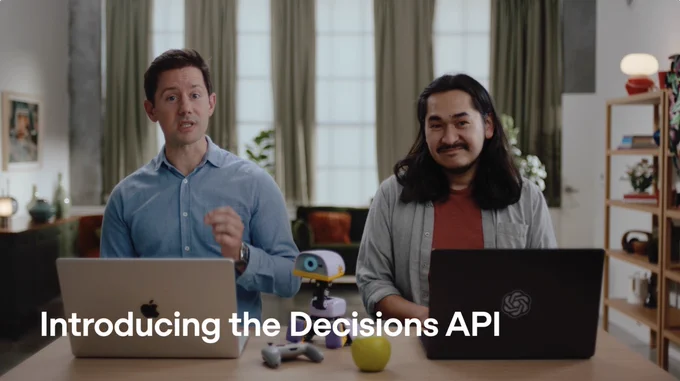
Let your app choose the right model, tool, or action in near real-time with Decisions API, now available to all developers in public beta.
The Decisions API makes decisions up to 10x faster than GPT-6 Luna through the Responses API.
320
466
5,114
2,087,904

Can confirm, it’s amazing

The contrast between hanging up the last phone call of the day of high-stakes decisions and then a minute later walking in the door to the pure love of small children who want to laugh and play and show you every discovery they made that day is the strangest and best thing I have ever experienced in life.
1
52