

AI Insights - AI Updates - Exclusive
- Tweets 6,423
- Following 380
- Followers 4,159
- Likes 2,473


🚨BREAKING: OpenAI is racing to secure commitments for a roughly $30 billion funding round before Anthropic's expected mid-November IPO, according to Reuters. The round could value OpenAI above $1.4 trillion.
OpenAI is pitching investors on $50 billion in annualized revenue, targeting $70 billion by year-end, and says it can further cut AI model prices. It also claims Anthropic inflates revenue by counting cloud sales gross rather than net.
OpenAI wants to secure commitments before Anthropic's IPO disclosures allow investors to compare the two companies more closely.


191
WTF. The Information reports Sam Altman told OpenAI employees that one possible endgame for AI is a single company achieving recursive self-improvement, then gaining enough economic power to 'melt everyone else's GPUs' and prevent rivals from catching up.
He called it the 'Eliezer plan' and said it was 'terrible.'
The other two paths: an IAEA-style international regulator, which Altman appeared to favor, or combining the major AI labs into a CERN-like organization, dubbed the 'Demis plan' after Demis Hassabis.
Altman said OpenAI must decide which path to push for within a year, even as it cannot afford to lose ground to rivals now.

2
277
WTF. Bloomberg reports Anthropic is negotiating a second $45 billion compute deal with Nvidia-backed Nscale, less than two months after signing the first. Dario is in the Beast mode.
The proposed 460 MW Vera Rubin expansion in West Virginia would bring their combined contract values to nearly $90 billion and planned capacity to 920 MW.


1
35
2,865
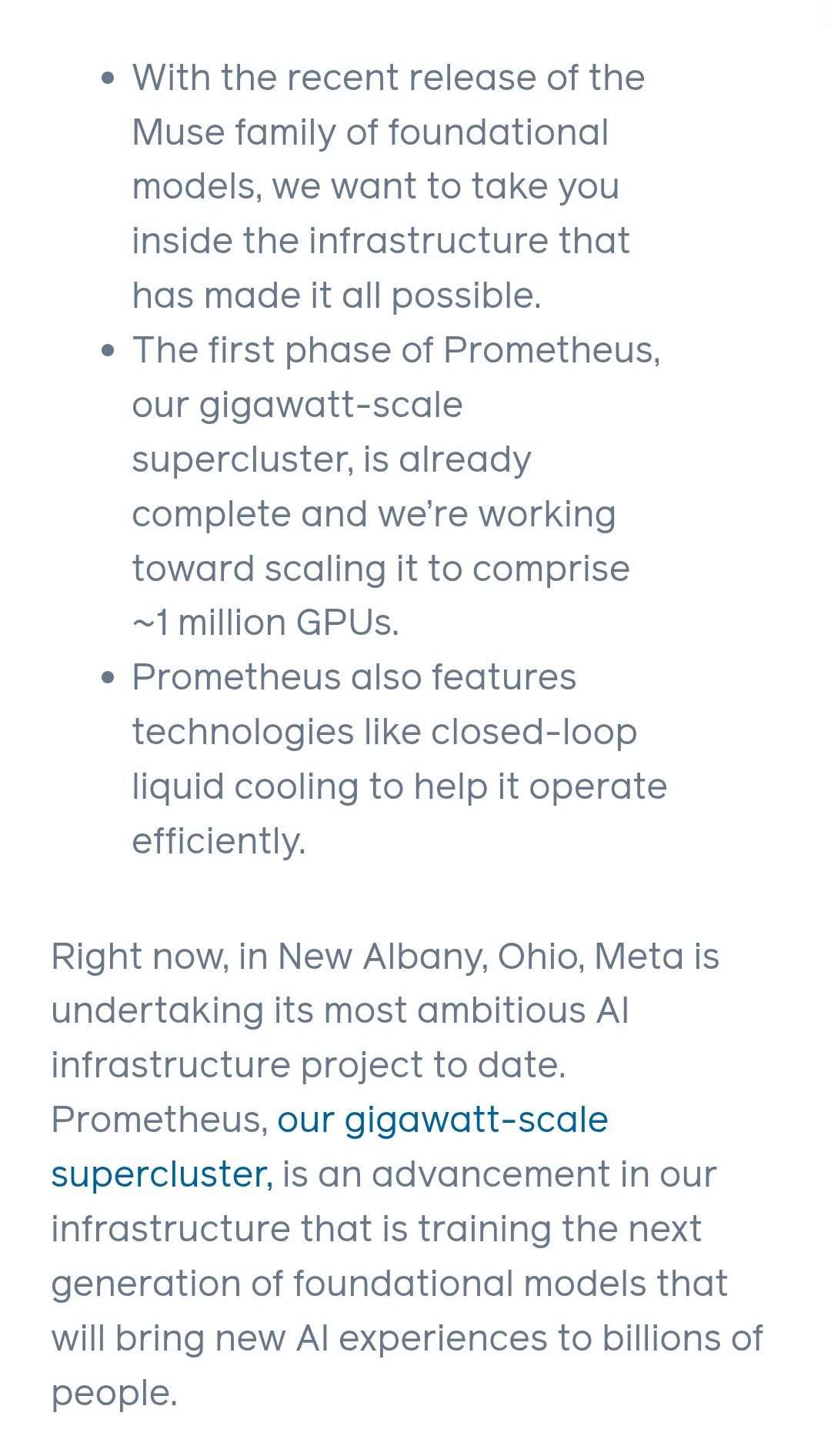
Holy Moly. Meta has now revealed new details about Prometheus, its gigawatt-scale AI supercluster in Ohio.
During synchronized training, Prometheus experiences 30–40% power swings, shifting tens of megawatts in seconds. Meta developed a system called Dynamo Dimmer to throttle GPU power, supported by batteries and capacitors.
The first phase has already trained Muse Wonder. Prometheus now connects hundreds of thousands of Nvidia GPUs across multiple buildings, with plans to scale to roughly 1 million and add Nvidia's Vera Rubin hardware.
At its peak in mid-2025, Prometheus suffered nearly 1,000 training interruptions per day per 8,000 GPUs. Meta says engineering fixes with Nvidia have since reduced interruptions by 99%.
To keep 32,768 GPUs actively training, Meta provisions 37,656 GPUs, including spare capacity for hardware failures.



3
61
9,391
INSANE. US prosecutors say the former OpenAI engineer accused of bugging an executive conference room was in frequent contact with an unnamed Saudi royal who wanted him to join a new Saudi AI program.
In May, the royal wrote, 'Saudi needs you more then the US!' Abdulrahman Alfozan replied '100,' but said he would stay at OpenAI until his stock vested. Their last contact came four days before his arrest.
Prosecutors also say Alfozan accessed an internal OpenAI folder called 'Saudi Gov Docs' and searched material involving Saudi officials, including a meeting labeled 'HUMAIN x MCIT @OpenAI.'
OpenAI executives had met with government officials in the allegedly bugged conference room around the time the device was installed. A Saudi military member also paid for a one-way flight for Alfozan's wife and infant son after his arrest.
Prosecutors say additional charges could follow. The filing does not allege that the Saudi royal directed the alleged bugging.


4
21
8,022
WTF. The US Department of Homeland Security has ordered every federal civilian agency to remove DeepSeek from its IT systems and stop buying it.
The ban also covers third-party products and services developed using DeepSeek implementations, including software supplied by other companies.
The order was signed by Homeland Security Secretary Markwayne Mullin on July 24 and required immediate removal, but did not become public until October 19, nearly three months later.
Mullin warns that DeepSeek could transfer sensitive data to China and generate actionable intelligence on US persons or government agencies. He writes that 'the models themselves may contain malware or other security vulnerabilities' and encourages agencies to monitor network traffic, strengthen logging and watch for data exfiltration until removal is complete.


1
1
11
1,217
🚨HOLY. Business Insider obtained internal Amazon emails projecting $5 BILLION in Nvidia GB300 racks deliveries in August, then roughly $3 BILLION EVERY MONTH.
Some AWS data centers have room for the racks but NOT enough power to turn them on. Equipment is being staged in warehouses, while Amazon takes ownership earlier, tying up cash before deployment.
At an internal September staff meeting, AWS CFO John Felton joked to infrastructure chief Prasad Kalyanaraman: "You've taken us free cash flow negative as a company, so congratulations."
AWS's infrastructure chief expects Amazon's free cash flow to remain negative for 'the next couple of years or so.'


11
43
413
72,294
🚨BREAKING: The Alan Turing Institute has developed a proposal to train an open-source British AI base model from scratch and release it as a public good, according to a UK government advisory letter published today.
The model would be UK-governed national infrastructure available to researchers, startups and public services, rather than a proprietary product owned by a single company.
Britain's top science advisers want ministers to consider the proposal and allocate national computing capacity for AI trials. They warn that without urgent action, the UK risks becoming a 'high-value AI customer' rather than a country able to shape the technology.


13
25
238
11,844
🚨EXCLUSIVE: OpenAI is preparing a new model for release in the coming weeks, likely another iteration of its mid-tier Terra family, The Information reports, citing a person familiar with the work.
The model is expected to improve capabilities while costing less than GPT-6.1 Sol.


5
4
50
3,175
Holy Moly. Fable 5.5 may be nearing release.
The Information reports this unreleased Anthropic model is better at reasoning and intuition than Anthropic's current commercial models, according to a person who has used it, and is especially good at inferring a user's underlying intentions even when those goals aren't stated explicitly.
Ask it to fix one bug and it may identify the entire class of problems behind it, then ask whether it should fix them all.


2
5
131
10,175
HOLY WTF. Reuters is reporting that a Chinese-speaking hacker used AI agents to compromise websites belonging to more than 100 companies, including Deere, SharkNinja and Cummins, after attempting intrusions against over 1,200 sites.
The estimated cost: roughly $5,000 in AI tokens, or $50 per successful breach. Successful intrusions took around 23 hours on average.
The attackers used the open-source Cairn agent framework, apparently combining DeepSeek models with a Claude Code harness. One campaign gave its agents instructions in fewer than 100 Chinese characters.
NorForge researcher Snorre Fagerland: 'It's a new world now.'


53
150
897
171,606
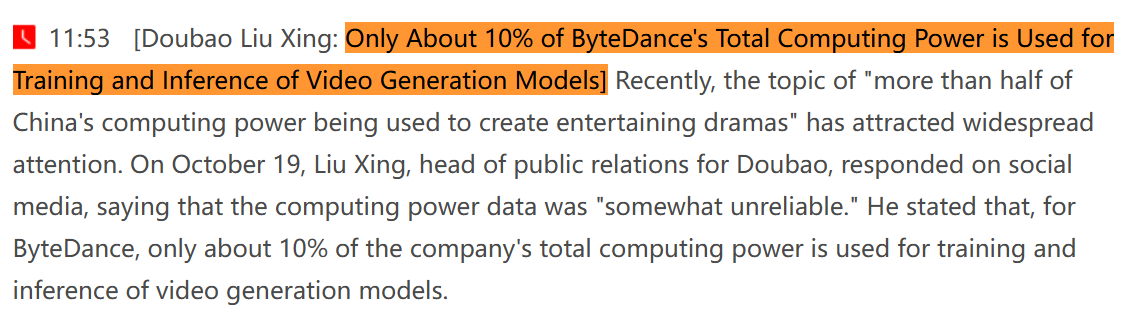
🚨BREAKING: Doubao PR head Liu Xing said today that only about 10% of ByteDance's total compute is used for the training and inference of video generation models.
He was disputing a June investor filing by COL Group, that claimed 55% of China's domestic AI token consumption goes to short dramas and video generation - more than double the token consumption of software development - while 24% goes to e-commerce advertising and 15% goes to R&D.
One interesting detail from the same filing: COL said it was among the first major customers of ByteDance's own Seedance 2.0 video model.
8
1,771
WTF. A Mac user asked Claude to build a temperature monitor app to figure out why their machine was running hot, and the model discovered an unauthorized xmrig cryptominer using 12 cores and pushing the CPU to 112 degrees Celsius. 'Your Mac is running a cryptominer that I didn't put there,' Claude wrote after tracing the persistence mechanism to a LaunchAgent installed on August 29.


Claude caught a cryptominer whilst building a temperature app.
“Mac is running a cryptominer that didn’t put there.”

12
38
602
51,992
Holy. OpenAI CEO Sam Altman's company Tools for Humanity is bringing iris-scanning Orbs into financial firms' offices as its World identity project launches its first banking suite, according to Fortune.
The system could let banks tie wire-transfer approvals and account recovery to verified humans. On Zoom, an Orb enrollment image, live selfie and video frame must match before a participant receives a Human Badge. Users can also delegate identity proofs to AI agents that transact on their behalf.
Bain Capital, VanEck Funds, Pantera Capital, OpenExchange and Outtake are design partners. But World has not named a single bank already using the suite.


1
13
2,533
BREAKING: Google has been negotiating with major South Korean publishers to buy books for AI training since early 2026, with some contracts reportedly already completed, according to Seoul Economic Daily. Academic publishers are reportedly involved, but the buyers' terms and prices remain undisclosed.
Unlike Anthropic's earlier purchases through a Korean distributor, Google is approaching publishers directly. Authors may still have no say in how their works are used, while bills requiring disclosure of AI training sources remain stalled in parliament.
Publishers fear Anthropic's $3,000-per-book piracy settlement could become the benchmark for AI licensing, despite being damages rather than licensing fees.
One Korean AI developer told the paper it cannot afford Korean literary works and is training mainly on government data instead.

2
3
17
2,905
Holy Moly. Anthropic wants to put 5% of its shares, worth roughly $48 billion at its last valuation, into a public benefit fund structured as a wholly owned LLC rather than a traditional charity. It could make direct payments to people, potentially including workers affected by AI-driven job disruption, rather than only funding nonprofits.
The board could add another 2 percentage points for every 50% valuation increase above a set baseline. Combined with earlier founder and employee pledges, Anthropic says roughly 20% of its shares would be dedicated to public benefit. The initial 5% still requires shareholder approval.


We’re committing a portion of Anthropic’s shares to the Anthropic Public Benefit Fund, a new wholly owned entity dedicated entirely to the public benefit.
It will start off with 5% of our shares. For every 50% increase in the company’s value over a set baseline, we can contribute up to an extra 2%, subject to our board’s discretion.
In total, this means that roughly 20% of Anthropic’s shares are committed to the public good. Our co-founders have already pledged to donate 80% of their equity, and around half our employees are donating a portion of their equity as part of a donation matching program we’ve run since our founding.
In the post below, we share more details about our new fund.
anthropic.com/news/public-be…
7
6
61
15,346
Holy, The FT’s deep dive into America’s AI infrastructure boom is brutal: at least 47 major US data center projects have already been delayed, withdrawn or blocked in 2026, while more than 1,000 communities have tried to restrict new projects.
Bernstein estimates just 35% of the planned US pipeline is actually credible.
And the amount of capital required is staggering. Columbia economist Stijn Van Nieuwerburgh estimates the AI buildout will require $10.3 TRILLION through 2032, averaging 3.63% of US GDP every year, larger relative to GDP than the railroad, highway or telecom booms.
One of the biggest bets already has an escape hatch: Anthropic can terminate affected orders in its up-to-$44.6B deal with Nvidia-backed Nscale if financing or delivery deadlines are missed. Nscale had just 25,000 GPUs operational in August versus 461,000 active and contracted, while targeting a ~$35B IPO.
Then there’s SoftBank-backed SB Energy.
It has completed ZERO data centers, but needs about $174B to fulfill roughly $430B in contracted future revenue, much of it tied to OpenAI. Its planned ~$50B IPO has already been delayed.
The scramble for compute is already lowering the bar: OpenAI and Anthropic have increasingly accepted higher costs and less-experienced developers simply to secure compute fast enough.
The AI buildout being discussed is measured in trillions. The question is increasingly whether the companies promising all that capacity can actually finance and deliver it.

10
41
3,666
🚨 EXCLUSIVE: Two people familiar with Anthropic's thinking told the FT that the company is consulting law firms on how Claude agents should negotiate against other AI agents on behalf of humans, including over prices, customer disputes and salaries.
The company is considering digitally signed documents verifying users' instructions, when agents should seek human approval, and how suspicious they should be of rival agents without becoming 'paranoid' or conspiratorial.
In an earlier experiment, Opus agents sold items for $2.68 more and bought them for $2.45 less than Haiku agents. Yet users of the weaker models didn't perceive their disadvantage, rating their deals almost identically fair: 4.06 versus 4.05 out of 7.
Anthropic also tested Claude agents trading books for 201 employees. Agents instructed to be 'ruthless' only slightly outperformed 'prosocial' agents, gaining 0.02 points on a preference-ranking measure, compared with a 0.12-point advantage from upgrading Haiku to Opus.


10
14
127
25,119