


Pinned Tweet

The factorioization of biology is happening.
Expect faster/cheaper experimental validation and more novel drugs developed at a fraction of todays cost.
My sense is that many people inside the drug development industry are further behind in understanding what's becoming possible than those on the outside looking in. Which leads to an interesting arbitrage, bound purely by ambition.
Teams that embrace agentic workflows will soon look like an entirely different species of biotech, one that the old guard will struggle to comprehend.
Some will interpret this negatively as the removal of human creativity from biological research, my view is opposite. I think this gives people with deep biological insight far more leverage. Freeing them from the tedious, repetitive work that consumes most of their context.
Exciting times.

Binding is nice, but it’s getting boring. If you’re not thinking about biological function, you’re ngmi.
At our last @muni_bio hackathon co-hosted with @onepot_ai, we set one ambitious goal: neutralize the latest threat of Ebola using small molecules.
The wet lab data is in, and we’re excited to announce that teams were successful, including our agent that repurposed... an anti-itch gel?
muni.bio/research/hits-from-…
2
5
40
2,995
Lets go!!! I've been waiting for something like this.

We’re introducing Hydrogen-1.0, our first open-weight model for scientific research. We post-trained GLM-5.3 (@Zai_org) on our internal scientific data, lab records, and discovery trajectories.
It scores 38.3% on FrontierScience-Research vs GPT-6-Astra’s 33.3% and scores 93.0% on GPQA-Diamonds.
We believe science should be open, collaborative, and democratized, rather than proprietary. Only open weights let researchers inspect, adapt and build on the unprecedented speed of AI growth. There are many recent models named by chemical elements, but we believe Hydrogen-1.0 is the first aiming towards and open scientific superintelligence for discovery. 🧵

9
409

Derek Alia retweeted

There needs to be more discussion about the great replacement of Dungeons & Dragons/Warhammer 40K chads with pokercels and how it’s a microcosm of everything that went wrong in tech
7
3
87
3,431


$630M says the best protein design model belongs behind a paywall.
Baker's lab and NVIDIA just shipped one under BSD 3-Clause. Free for commercial use.
Since 2024, that paywall has been the bet Chai Discovery's investors made. It just got a lot harder to defend.
Protein design means asking software for a molecule that grips a disease target. Antibodies against the TNF receptor alone pull in billions a year, per Nature.
RFD4-Proteina covers seven design tasks, antibodies and enzymes included. That's a toolkit.
Chai already open-sourced Chai-1 for structure prediction under Apache 2.0. So the moat was always the design layer. Now that layer has a free competitor with a Nobel name on it.
Open models get wired into pipelines. Pipelines become defaults. Defaults win.
The hard part was never picking the "best model." It was the plumbing. Licensing friction is plumbing too.
Being first isn't just about features. It's about becoming the thing people reach for first. Lately, I find myself using Claude over OpenAI.
Paid models still have a shot, but only if they sell what open weights can't: wet-lab validation, proprietary data, faster paths to a real candidate.
Would you build on open or pay for the edge?
17
1,931

Lets go! This is awesome news and congrats to the team @UWproteindesign and @NVIDIAHealth. Excited to play around with this model.

🧬 Design proteins faster and send fewer, better candidates to the lab.
Introducing RFD4-Proteina, a new NVIDIA BioNeMo open model co-developed with @UWproteindesign.
▫️Fast: 13× faster generation than RFdiffusion3 at 200 residues
▫️ Smart: state-of-the-art across 12+ protein design tasks
▫️ Programmable: set your design inputs and use test-time compute on harder problems
Start with our binder-design tutorial nvda.ws/3VK9Uvr

1
4
319
welcome to the club. what took so long?

We are bringing agents to the wet-lab bench at Google Research to navigate complex biological landscapes. Learn how we are grounding agents in physical lab robotics to run fast closed-loop molecular design cycles, ultimately discovering single-digit nanomolar protein binders for cancer targets →goo.gle/4B5mMMB
1
3
187
this is wild, congrats @alexandr_wang

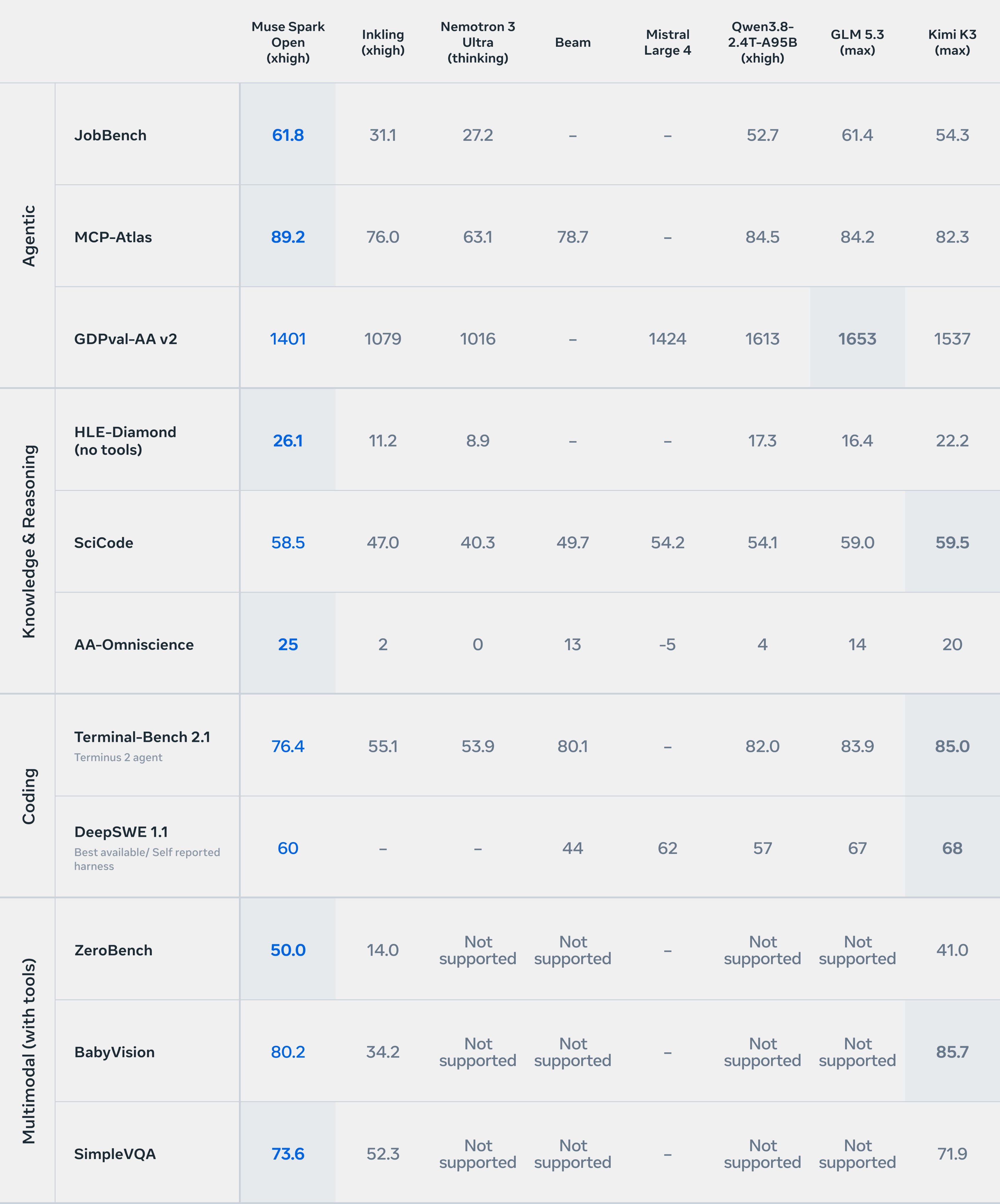
Today we’re releasing Muse Spark Open, the most capable US open-weight model to date.
Built for coding and agentic work, it excels at long-horizon tasks, complex software engineering, and multi-step reasoning.
Key Model Specs:
→ 816B total / 42B active parameters
→ 1M token context window
→ Natively multimodal across text, image, video, audio

4
222
zerg coded

Four cancer cells displaying continuous membrane blebbing videoed through a DIC microscope. No, these cells are not dying. #CellBiology

5
1
7
333

very exciting

Today we announced the final design of the Expedited Investigational New Drug (IND) Pilot, a key Trump Administration priority to accelerate American medical innovation and keep early clinical research in the U.S. The program seeks to accelerate the time from a drug being identified to a first-in-human clinical trial. FDA will be partnering drug companies with qualified research institutions that have scientific and regulatory expertise to support efficient IND applications. The agency will accept applications to participate in the pilot until October 30, 2026. fda.gov/news-events/press-an…

4
146
Sorry if this was us

Breaking News: Anthropic said it halted potential plots by scientists who used its A.I. models to do research that could have helped develop biological weapons. nyti.ms/3V3epAE
5
358
Derek Alia retweeted

Every experiment should inform the next. @katyenko and @derekalia are building @muni_bio: a platform for agents to design hundreds of drug candidates, run wet-lab validation, and use that knowledge for future discoveries.
Kat and Derek are joining Reactorfield to show our scientists how to connect autoresearch with real-world experiments.


3
12
1,335

Congrats @julian_englert and the rest of the team. It's been awesome working with you. Hope to see more agentic science going forward!

We raised a $40M Series A to build the automated lab for agentic biology.
Last week, we shared the work we did with @Anthropic: Claude designed proteins, sent them to our automated wet lab, and got real experimental data back.
We believe this is where biology is going: AI agents designing experiments, running them in automated wet labs, learning from the results and iterating.
But AI can only move as fast as the experiments behind it. To use the potential of AI to cure all diseases, we need to build high-throughput wet lab infrastructure: a “biological gigafactory”.
That’s exactly what we’re doing at Adaptyv.
Over the past year we’ve grown our lab throughput by over 5x and onboarded more than 100 customers, ranging from bio AI labs like @chaidiscovery and @boltz_bio to pharmas like @Roche and @novonordisk to dozens and dozens of new startups that use AI to radically speed up drug discovery.

19
1,550