

Tech, games and whatever the internet did today. I also build small apps.
- Tweets 578
- Following 197
- Followers 46
- Likes 591



AI can have a little bit of mass casualties (up to 49 people and $999M), as a treat.
tomshardware.com/tech-indust…
2
24
claude with REA is on crack. also since when does it do what i tell it to do? it used to refuse a lot before

1
14
claude with REA is on crack. also since when does it do what i tell it to do? it used to refuse a lot before REA was out
Karabo on X: "say less, behole the result for the github.com/morluto/rea
 Karabo
2
29

Karabo retweeted

Technical moats are mostly over at this point. If you’re building something that is meant to be durable, the only moats now are:
• Proprietary data
• Network effects
• A physical component
1,149
2,082
25,755
3,294,231
free open-source tools are still my first pick, but once you plug your own paid API key into one, a breach on their side can end up on your card

We had a security breach last night related to a large scale distillation attack that impacted 1.4% of OpenCode Console users
We have notified them all this morning via email. If you did not get an email you were not impacted, it was a subset of users who had external providers linked
The incident is ongoing so we cannot share more details at this point but we are working with Anthropic, OpenAI, and Google to remediate
2
37
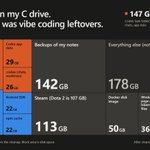
I vibe code and never clean up after it. My C drive had 30 GB left, so I finally looked.
273 GB of it was leftovers. More than half of that was Codex.
Codex alone: 55 old task folders (92 GB), a 26 GB .codex folder, and 29 GB of app data that is mostly a second Android SDK. Then ten emulators (82 GB), another Android SDK (22 GB) and a 22 GB npm cache.
To see how bad yours is, send this to Claude Code or Codex:
“Scan my drive read-only. Check folder sizes only and do not open any files. Find what AI coding tools and the apps they built left behind: chat history, old task outputs, git worktrees, emulators, SDKs, caches, Docker images. For each one show the path, the size and what breaks if I delete it, and mark it safe to delete or ask me first. Do not delete anything yourself.”

6
1
6
118
opus 5.5 on medium has been extremely slow for me since the recent updates. high runs okay. somehow the middle setting is now the slow one
18
AI benchmarks mostly test the work that was easy to write a test for. the rest of a normal job is unclear emails, half-broken setups and people who can't explain what's wrong, and nobody is scoring that (for now!!)

Mercor Research mapped AI benchmarks to actual US jobs.
Only 208 of 923 occupations in the US economy are represented by existing AI benchmarks. 90% of hours worked in the US aren't covered well by a relevant AI benchmark.
Today, we’re releasing the 𝗕𝗲𝗻𝗰𝗵𝗺𝗮𝗿𝗸 𝗠𝗮𝗽 𝗼𝗳 𝘁𝗵𝗲 𝗨𝗦 𝗘𝗰𝗼𝗻𝗼𝗺𝘆, an interactive breakdown of which economic tasks are covered by AI benchmarks.
Benchmarks are how we measure AI’s progress and anticipate its impact on real work. They’re crucial to understand which jobs AI can automate, where the biggest gaps are, and how those capabilities are changing over time.
The Benchmark Map is our first step toward building a resource that makes it easier to answer: 𝘋𝘰𝘦𝘴 𝘵𝘩𝘪𝘴 𝘈𝘐 𝘮𝘰𝘥𝘦𝘭 𝘸𝘰𝘳𝘬 𝘧𝘰𝘳 𝘮𝘺 𝘰𝘤𝘤𝘶𝘱𝘢𝘵𝘪𝘰𝘯?
Explore it here: mercor.com/research/labor-in…

1
2
38
AI benchmarks mostly test the work that was easy to write a test for. the rest of a normal job is unclear emails, half-broken setups and people who can't explain what's wrong, and nobody is scoring that (for now!!)
Mercor Research mapped AI benchmarks to actual US jobs.
Only 208 of 923 occupations in the US economy are represented by existing AI benchmarks. 90% of hours worked in the US aren't covered well by a relevant AI benchmark.
Today, we’re releasing the 𝗕𝗲𝗻𝗰𝗵𝗺𝗮𝗿𝗸 𝗠𝗮𝗽 𝗼𝗳 𝘁𝗵𝗲 𝗨𝗦 𝗘𝗰𝗼𝗻𝗼𝗺𝘆, an interactive breakdown of which economic tasks are covered by AI benchmarks.
Benchmarks are how we measure AI’s progress and anticipate its impact on real work. They’re crucial to understand which jobs AI can automate, where the biggest gaps are, and how those capabilities are changing over time.
The Benchmark Map is our first step toward building a resource that makes it easier to answer: 𝘋𝘰𝘦𝘴 𝘵𝘩𝘪𝘴 𝘈𝘐 𝘮𝘰𝘥𝘦𝘭 𝘸𝘰𝘳𝘬 𝘧𝘰𝘳 𝘮𝘺 𝘰𝘤𝘤𝘶𝘱𝘢𝘵𝘪𝘰𝘯?
Explore it here: mercor.com/research/labor-in…
1
31
if you're not a developer and want to try vibecoding, start with a tool only you will use. you already know exactly what it should do, and when it breaks you're the only one annoyed.
1
22
say less, behole the result for the github.com/morluto/rea

Paste this into Claude Code and any GitHub repo becomes a 45-second explainer video.
Install the two tools first:
claude plugin marketplace add heygen-com/hyperframes
claude plugin install hyperframes@hyperframes
npx skills add cathrynlavery/diagram-design
Then paste:
"Make a 45-second explainer video for this GitHub repo: [URL]
1. Read the README. Tell me in one sentence what the project does, who it's for and the single most impressive thing about it. Wait for my OK.
2. Script, 1080x1920:
0 to 3s: the problem it solves, in 6 words or fewer, in big kinetic type
3 to 10s: the project name and what it replaces or makes possible
10 to 32s: its 3 best features, one scene each. Use diagram-design for anything that needs a diagram, and real screenshots from the README where they exist.
32 to 40s: the exact install command from the README, typed out on screen
40 to 45s: the repo URL
3. Snappy motion, no stock footage, captions on every scene.
4. Only use facts from the README. Show the star count only if it's visible on the page.
5. Show me 5 still frames, one per scene, for approval. Then render the MP4."
1
1
46
C was Argon
A Fable 5.1: 4 min 36 s, $1.09 B Opus 5.5: 11 min 14 s, $1.43 C Argon: about 2 min
Argon ran in the Gemini app, which shows no cost. its intro price is $2 in / $10 out per million tokens. Opus is $4 / $20, Fable $10 / $50

2
70
Gemini 4 Argon is out in the Gemini app, so I gave it, Opus 5.5 and Fable 5.1 the same prompt
"a fox walking through a snowy forest at night under the northern lights"
each one wrote an animated web page from scratch. one of these is Argon. which one?


1
115
if you've tried argon in antigravity, the review i'd actually want is the boring one. what you asked it to build, where it got stuck, and whether it was any faster than what you used before.
1
17
Chat, regarding the Anthropic Monthly API Credits, will new accounts receive it, cause i ain't got it yet?
1
17
how do we do it right?
i use codex and claude code on the same project: i put @AGENTS.md in CLAUDE.md and both tools read the same rules. one file to keep up to date?
is that how you do it?
3
2
33
Same cat prompt, Haiku 5.5 on three effort settings
low: 1 min 36 s, $0.011
medium: 2 min 23 s, $0.017
high: 5 min 08 s, $0.037
low is 3x faster and 3x cheaper. the cat comes out smaller, but it's still a cat on a skateboard at sunset

answer to the cat test: B was Haiku 5.5
A Opus 5.5: 9 min, $1.16
B Haiku 5.5: 5 min, $0.04
C Fable 5.1: 2.5 min, $0.71
here's the whole race

1
19
answer to the cat test: B was Haiku 5.5
A Opus 5.5: 9 min, $1.16
B Haiku 5.5: 5 min, $0.04
C Fable 5.1: 2.5 min, $0.71
here's the whole race
Haiku 5.5 came out yesterday. I gave it, Opus 5.5 and Fable 5.1 the same prompt
"a cat riding a skateboard through a city at sunset"
one of these costs $0.04. the other two cost $0.71 and $1.16
which one is Haiku?


2
70